
HeatStopper® – Certified GREEN – Prevents Overheating, Fire, and Explosion
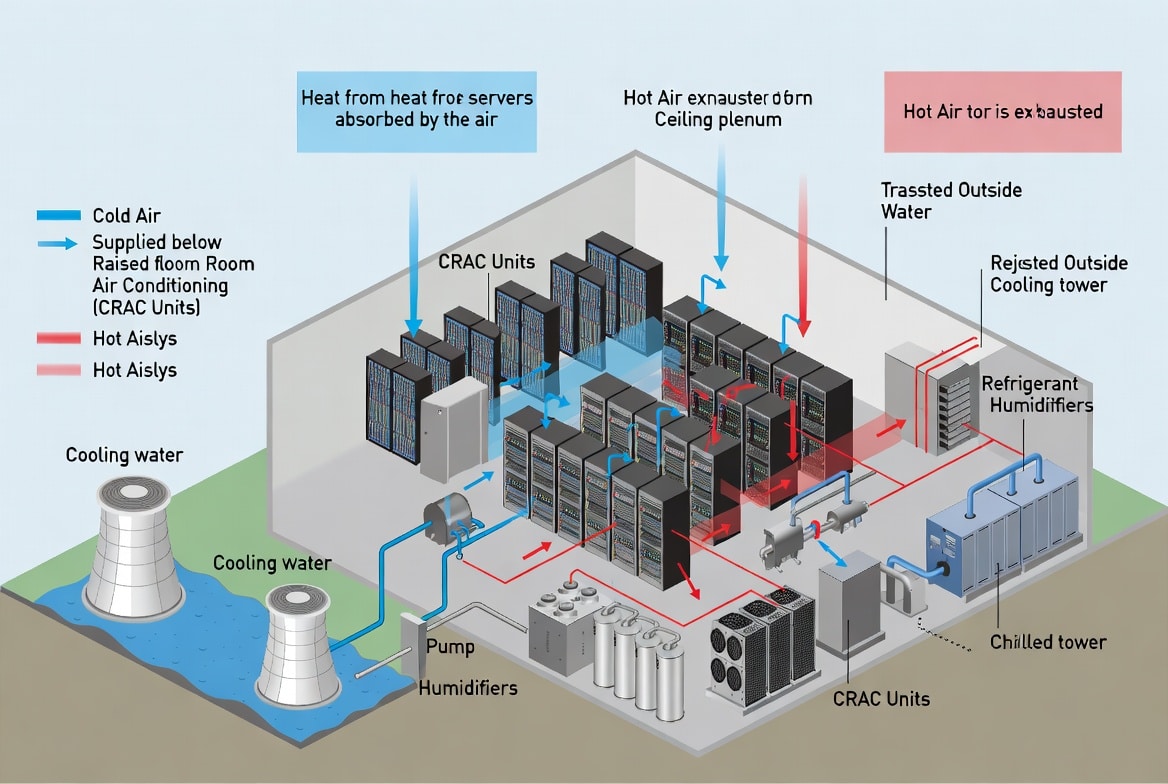
How Data Center Cooling Systems Work
Data centers generate enormous amounts of heat from thousands of servers running 24/7. Effective cooling is critical to prevent hardware failure and maintain efficiency. Here’s a simplified overview:
- Airflow Management (Hot/Cold Aisle Containment): Servers are arranged in rows with cold aisles (fronts facing each other) where cool air is supplied, and hot aisles (backs facing each other) where hot exhaust air is collected. This prevents mixing of hot and cold air.
- Computer Room Air Conditioning (CRAC) or Air Handling (CRAH) Units: These units blow cold air into the space (often under a raised floor). They use chilled water or refrigerant to cool the air.
- Chilled Water System: Water is chilled by large chillers (often using compressors and evaporators) and pumped to the CRAC units or in-row coolers. The warm water returns to be re-chilled.
- Heat Rejection: Heat is ultimately transferred outside via cooling towers, where water evaporates to dissipate heat into the atmosphere, or dry coolers.
- Efficiency Features: Modern systems use free cooling (economizers) when outside air is cold, variable speed fans/pumps, and advanced monitoring to optimize energy use (cooling can account for 30-50% of a data center’s power consumption).
This setup keeps server inlet temperatures typically between 18–27°C (64–80°F) as recommended by ASHRAE. Liquid cooling (direct-to-chip or immersion) is increasingly used for high-density AI workloads alongside traditional air cooling.
The Challenge – Cooling and Water
Servers need to stay cool at the intake — modern guidelines recommend between 64 and 81°F (18 to 27°C) for the air entering the front of the servers. Many facilities aim for the upper 70s to save on cooling power.
Without cooling, the chips inside get extremely hot. CPUs and GPUs under heavy load can hit 80 to 100°C (176 to 212°F) or more at the chip level before they throttle or shut down.
In the room itself, the hot aisle — where the exhaust air comes out the back — can easily reach 105 to 120°F (40 to 49°C) or higher in dense setups. That’s why proper airflow separation between cold and hot aisles matters so much.
Many data centers use water for cooling. A single large data center might use 1 to 5 million gallons of water a day, stressing towns in dry areas.
In 2023 a study showing U.S. data centers directly consumed about 17.4 billion gallons of water annually — that’s roughly 48 million gallons of water per day. By 2028, that could double or quadruple to 38 to 73 billion gallons of water a year!
The Solution
Replace Water with HeatStopper®
- Prevents Fire and Explosion.
- Lowers Temperatures from 1800° F to Ambient in Seconds.
- Both Endothermic and Exothermic.
- Low Evaporation Environment.
- Non-Corrosive.
- Non-Aggressive.
- Biodegradable.
HeatStopper® Could Integrate Effectively into a Closed-loop System as an Additive or Component in the Circulating Fluid, leveraging its described properties for enhanced thermal management.
Closed-loop liquid cooling (common in modern data centers) recirculates a sealed fluid—often water-glycol mixes or dielectric fluids—through cold plates or immersion setups. Heat is absorbed at the servers, transferred via heat exchangers to external rejection (dry coolers, etc.), and the fluid cycles back. No evaporation or constant top-up in true closed designs.
Strong fit based on its properties:
• Heat absorption + endothermic/exothermic capabilities: This aligns well with Phase-Change Materials (PCMs) or thermochemical storage used in advanced cooling. It could act as a buffer—absorbing excess heat spikes (endothermic) from high-load AI/GPU servers and releasing it (exothermic) during lower demand or to aid heat rejection. This smooths temperature fluctuations, reduces peak loads on pumps/chillers, and improves overall efficiency.
• Catalyst aspect: Catalysts can enhance heat transfer reactions or fluid dynamics without being consumed. In a closed loop, longevity is key—it wouldn’t deplete quickly.
• Radiation absorption: Could help manage infrared/thermal radiation within the system or at exchanger surfaces, complementing convective liquid cooling.
• Safety profile (noncorrosive, non-aggressive, nontoxic, biodegradable): Excellent for closed loops. Existing systems already use inhibitor packages to prevent corrosion and biological growth. A biodegradable, nontoxic additive reduces maintenance risks, environmental impact if there’s any leak, and compatibility issues with metals, seals, or electronics.
Practical integration:
• As a fluid additive: Dosed into the primary coolant loop at low concentrations. It would circulate with the fluid, actively managing heat at the source (near chips) and throughout the loop. Pumps would need to handle any viscosity changes, but non-aggressive nature helps.
• In heat exchangers or coatings: Applied to surfaces for localized absorption/radiation management.
• Benefits in data centers: Lower energy for pumping/cooling (better PUE), better handling of variable AI workloads, reduced reliance on oversized chillers, and potential for more compact systems.
Potential considerations:
• Long-term stability: In a sealed loop, it must remain dispersed without settling, degrading, or reacting over years. Biodegradability is great for end-of-life but needs testing for loop lifetime.
• Concentration and testing: Optimal dosing to avoid impacting heat capacity, flow rates, or pressure. Compatibility with existing glycols, inhibitors, or dielectrics is crucial.
• Heat rejection: The loop still needs to dump heat externally. HeatStopper® could enhance exchanger efficiency but wouldn’t eliminate the need for radiators/coolers.
• Regulatory/safety: Nontoxic/biodegradable is a big plus for approvals, especially in large-scale deployments.
Watch

Certifications
Associated Labs – Environmental
Pace Analytical Labs – EPA 1633 PFAS Gexcon, AS – Anti-Explosion
ICAO Level B – Aircraft
NAMSA – Medical
OPUS – Marine
SPL – Anti-Corrosion
UL 711 – Fire
 English